Continuous pulsating extractors
Ingehim offers proprietary in-house continuous pulsating extractors (CPE). The CPE represents a new class of heat and mass transfer equipment and is the only promising alternative to traditional extractors such as macerators, percolators, and screw extractors. The CPE is designed to produce extracts from raw materials of plant, animal, mineral, or synthetic origin within the “liquid extractant–solid phase raw material” system. Recommended applications for the CPE include the food, pharmaceutical, cosmetic, chemical, oil refining, metallurgical, and other industries. In some sectors, the extraction process may be referred to by different names depending on the industry. For example, it is called “diffusion” in the sugar industry and “leaching” in the metallurgical and chemical industries.
The CPE process is based on the original method of technologically transporting a solid dispersion (raw material) in countercurrent with a liquid extractant (solvent) inside a column apparatus without using any internal mechanical devices (Fig. 1). Raw materials continuously move inside the apparatus in a “piston” mode by applying low-frequency forced pressure pulses to the solid phase mixture from an external pulse-generating system. Structurally, the CPE consists of a single-body hollow column apparatus (Fig. 2) with no internal mechanical devices. The required capacity is achieved by adjusting the parameters of the external pulse-generating system and selecting the CPE dimensions according to the flow rate of continuously processed raw materials, the physicomechanical properties of the raw materials and extractant, and the process conditions (time, temperature, pressure, etc.).
 Fig.1. General view of the CPE
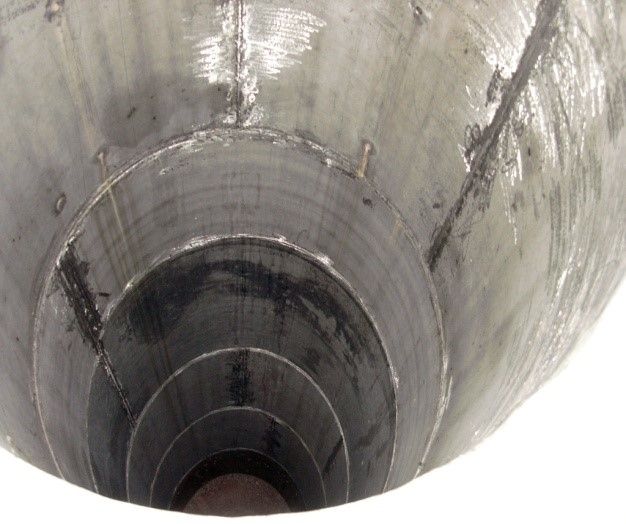 Fig.2. Working section of the CPE
The following video demonstrates the operating principle of the CPE.
Water, ethanol, propylene glycol, acetone, alkalis, acids, and other active agents, as well as their aqueous solutions, can be used as liquid extractants. Solid materials of various origins serve as raw materials. For extractions from plant-based raw materials, different parts of the plants can be utilized, such as roots, stems, leaves, buds, inflorescences, grains, fruits, or seeds, either in a fresh or dried state. Some raw materials require pretreatment, including drying, crushing, soaking, or scalding. Figure 3 illustrates an example of a technological process employing the pulsating extraction (diffusion) method for sugar beet, with a capacity of 6,000 tons per day, used in sugar production. The use of the CPE significantly reduces energy and operating costs, metal consumption, and production space, while increasing sucrose yield and improving extract quality. A comparative overview of diffusion apparatus is provided in Table 1.
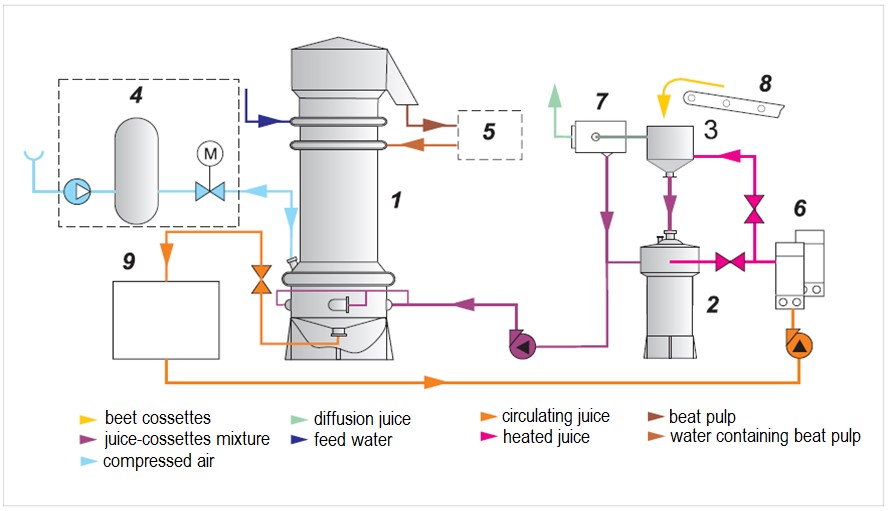 Fig.3. Example of a technological scheme implementing the pulsating extraction (diffusion) method for sugar production.
1 – diffusion pulsating apparatus (CPE); 2 – cossettes scalder; 3 – cossettes heater; 4 – pulse-generating system; 5 – beat press section; 6 – juice heater; 7 – beat pulp catcher; 8 – band conveyer; 9 – accumulator of juice
Table 1. Comparative characteristics of diffusion apparatuses with a capacity of 6,000 tons/day.
|
Parameter name |
Diffusion apparatus type |
|||
|
CPE Pulsating apparatus |
CDA Apparatus manufactured by BMA company |
RDA Rotary apparatus |
DS Screw apparatus |
|
| Aparatus type | column | column | rotary | double-screw |
| Positioning | vertical | vertical | horizontal | at inclination |
| Transportation method | by pulses | mechanical | mechanical | mechanical |
| Presence of internal transporter elements | none | hollow shaft, counter blades |
rotation of entire apparatus |
double-screw, counter blades |
| Sugar beet capacity, t/day | 6000 | 6000 | 6000 | 6000 |
| Beet cossettes characteristics, m/100g | 6-16 | 8-12 | 14-16 | 13-15 |
| Additional cossettes crushing during operation | none | significant | insignificant | significant |
| Volume utilization factor | 0.93-0.98 | 0.65-0.75 | 0.3-0.4 | 0.75-0.8 |
| Air contact zone size | absent | minimum | maximum | medium |
| Diffusion time, min | 65-80 | 76-80 | 65-70 | 60-65 |
| Working zone diameter, m | 6 | 8 | 6 | 8 – 9 (equival.) |
| Working zone length, m | 15 | 20 | 43.5 | 35 |
|
Overall dimensions, m Height Length Width |
20 8 8 |
25 9 9 |
15 43.5 12 |
13.4 8.8 34.5 |
| Total power consumption, kW | 90 | 120 | 175 | 320 |
| Apparatus weight, t | 180 | 300 | > 300 | >300 |
The CPE is available in various designs: airtight, capable of operating in a closed loop; with removal of volatile components or with a mixture supplied for oxidation; featuring fire and explosion safety; and offering a high degree of protection against dust and fumes. Upon customer request, the CPE configuration may include additional components and equipment for the preparation, supply, and removal of raw materials and extractants; for cleaning and collecting the extract; for recycling and regenerating the extractant; for instrumentation and automation systems; and other elements. Materials for the extractor may include ASTM A570 Gr36, ASTM A516 Gr70, AISI 304, AISI 316, and others. The CPE can be supplied separately on its own support or as part of a pulsating unit mounted on a frame, with arrangements for additional external devices, service platforms, and other elements.
The advantages of the CPE compared to existing extraction apparatuses:
1. Potential for large-scale processing of solid-phase raw materials with optimal economic efficiency in the technological process.
2. Continuous, countercurrent extraction in non-stationary phase interaction conditions provides the maximum possible yield of the target components.
3. Reduction of the extractant flow rate required for extraction to a phase ratio of 1:1 to 1:4, thereby increasing the final concentration of the extract.
4. Improvement of the quality of the obtained extract by optimizing the extraction process, reducing extraction time, preserving the structure of the raw materials, and minimizing oxidative, bactericidal, and other adverse effects.
5. Reduction of operating costs for extraction and subsequent processing of the extract (filtration, evaporation, drying, etc.), resulting in increased energy efficiency, cost savings, and reduced space requirements.
6. Enhanced safety achieved by performing extraction within a sealed apparatus and a closed-loop system.
7. High competitiveness in import substitution and pricing strategies.
The implementation of breakthrough instrumental and technological solutions based on the CPE extractor will enhance competitiveness and secure a leading market position. For example, the introduction of a CPE extractor with dimensions up to 1 meter in diameter and 5 meters in height enables the processing of up to 400 kg/h of cereals, eliminating the need for 21 apparatuses (three extraction lines with seven percolators each), each measuring 0.7 meters in diameter and 4.5 meters in height.
To order continuous pulsating extractors, please provide us with the initial data and all required specifications via email.
 COMPANY PRESENTATIONS
 PRODUCT CATALOGUES
 VIDEO
VIDEO