Study of plant raw materials
Ingehim provides services for analyzing various plant materials and the waste generated from them.
The specific nature of plant raw materials requires large-scale processing. Consequently, equipment with large unit capacities and/or numerous apparatuses are typically employed. This leads to low energy efficiency in production and high operating costs.
The most effective method for processing plant raw materials and the wastes they generate is complex processing, which produces multiple marketable products such as protein, inulin, pectin, fiber, and dyes that are in demand. Processing plant raw materials yields products with higher market value, while processing their wastes generates additional income through new commercial products. These products are obtained both by extracting specific target components and by converting biomass into feed additives or fertilizers.
Research directions:
1. Determination of the composition of raw materials to identify the presence of extractable target components.
2. Evaluation of the technical feasibility of obtaining new or additional commercial products by extracting the specified target components in both laboratory and pilot plant settings.
3. Assessment of the conditions required for industrial implementation in the production of new commercial products.
4. Conducting a technology audit and optimizing the processing technology of existing enterprises to reduce the cost of commercial products through the use of modern, energy-efficient solutions (such as extraction, separation, filtration, etc.), utilizing both proprietary and third-party technologies.
5. Assessment of the expected economic efficiency resulting from the modernization and optimization of existing units.
6. Feasibility study for a new production line, considering the implementation of new technological and technical solutions.
Upon agreement with the customer, samples of liquid extracts and final commercial products can be obtained using a pilot pulsating unit (PPU) within a specified temperature range, utilizing real media.
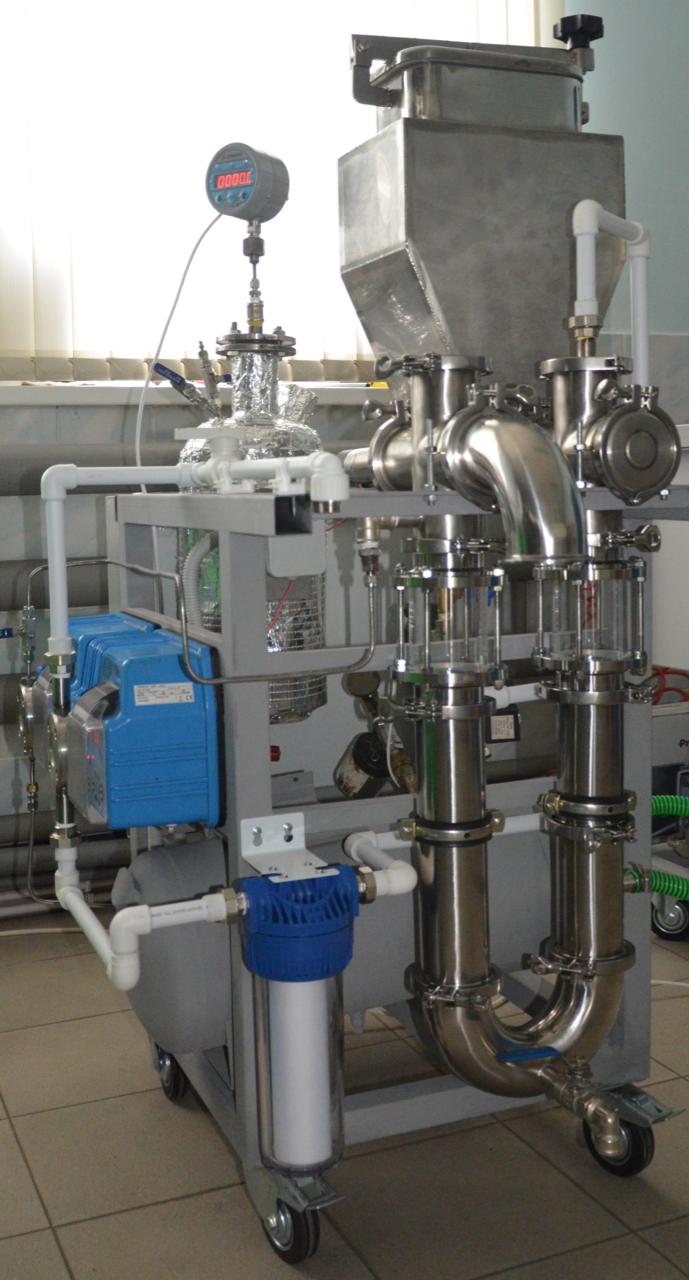
Technical characteristics of the PPU:
- Feed capacity: up to 5 kg/h.
- Material of construction: stainless steel, chosen to prevent adverse reactions between the raw materials, extractant, and the metal.
- Extraction is conducted in a continuous mode, with simultaneous supply and removal of both the raw material and the extractant. This process prevents the development of oxidative and bacteriological reactions during extraction.
- Extraction is performed in a non-stationary, countercurrent mode of interaction between the raw materials and the extractant. This approach ensures the maximum possible concentration gradient at the phase boundary, significantly reduces the consumption of the extractant, increases the concentration of the resulting extract, and intensifies the extraction process.
If necessary, the test results can be verified by an accredited laboratory.
To conduct the study, it is necessary to reach an agreement with the customer regarding the technological conditions of processing, initial data on raw materials and extractants, requirements for the obtained extract, the final commercial product, and other relevant factors. Based on this information, the cost of our service for studying the raw materials within the specified scope and established deadlines is estimated.
 COMPANY PRESENTATIONS
 PRODUCT CATALOGUES
 VIDEO
VIDEO